
Reduction of Alkynes
Alkynes, with their distinct triple bonds, are versatile reactants in the expansive world of organic chemistry. Their reduction opens up a myriad of hydrocarbon possibilities.
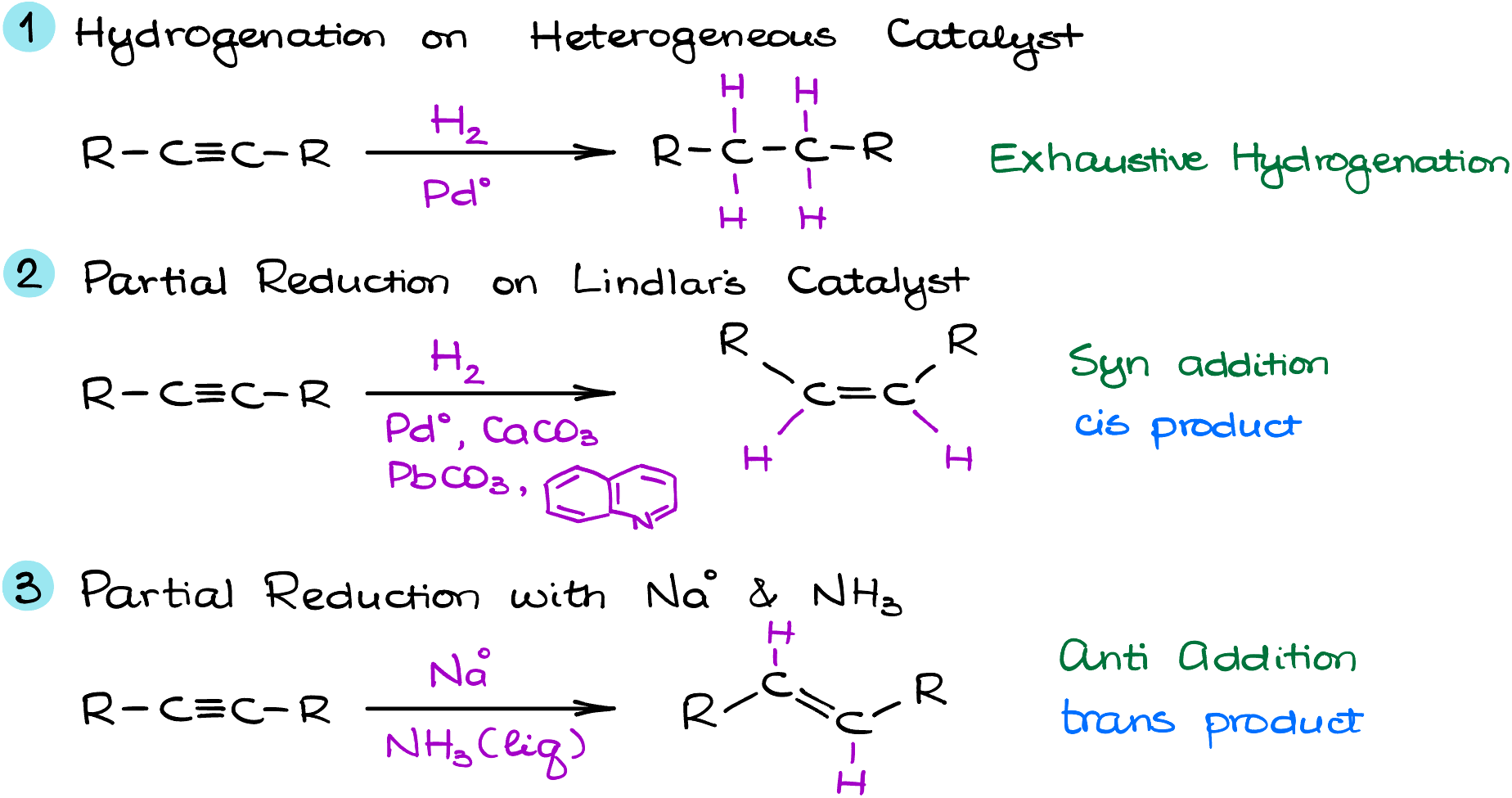
Exhaustive Hydrogenation: The Universal Triple Bond Eraser
The first reaction we’re going to look at is a simple exhaustive hydrogenation of alkynes. Just like the reduction of alkenes, this reaction reduces your molecule all the way down to a carbon-carbon single bond. And as with the reduction of alkenes, there’s no classic mechanism for this reaction, but we can draw the next best thing.
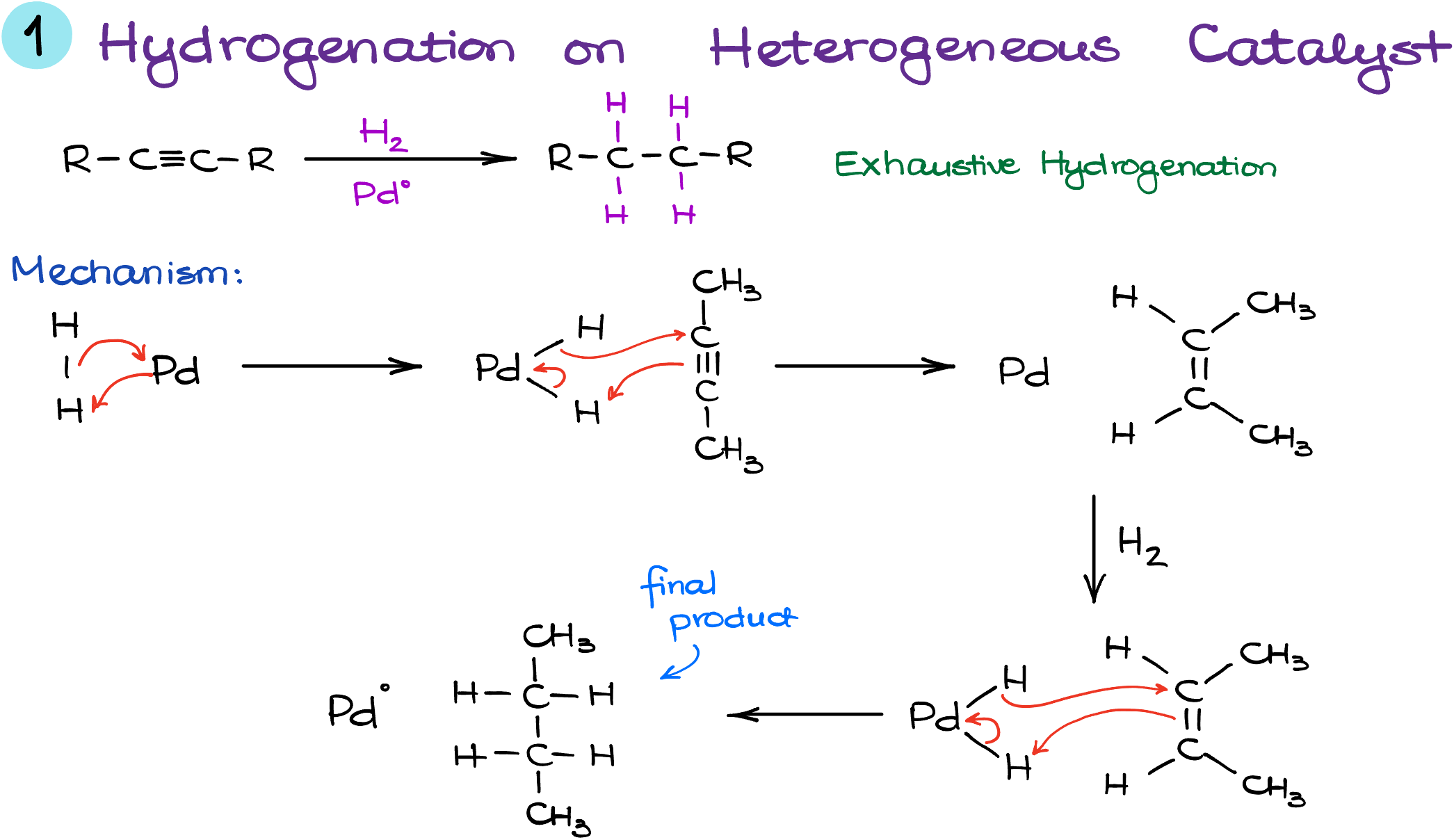
First, hydrogen gets adsorbed onto the metal surface, and we can imagine that each hydrogen atom makes a bond with the metal catalyst. Then the alkyne molecule picks up those hydrogens simultaneously. This is a concerted process, so both hydrogens jump onto our carbons at the same time. This yields a cis alkene, so both hydrogens end up on the same side, because this process is a syn addition.
But the reaction doesn’t stop there, and this addition happens one more time. In the next step, the alkene from the previous step picks up another pair of hydrogens from the surface of our catalyst, giving us a final product that looks like this.
So this reaction is useful if you need to get rid of your triple bond completely. I don’t know why you’d want to do that, since alkynes are pretty synthetically versatile, but you know, who knows. So this is essentially your universal triple bond eraser. This reaction shows up on tests quite regularly, so you definitely need to know it. You can also use all the same catalysts you saw in the reduction of alkenes, so we’re talking about platinum, palladium, palladium on carbon, and so on. All of those guys.
Now that we’ve journeyed from an alkyne to an alkane, it’s time to embrace the more intricate pathways that alkynes have to offer. Buckle up; things are about to get even more captivating!
Partial Reduction with Lindlar’s Catalyst
So the regular hydrogenation of alkynes gives us a single bond; it’s an exhaustive hydrogenation. Well, what if I don’t want to reduce it all the way? In that case, I have a couple of options.
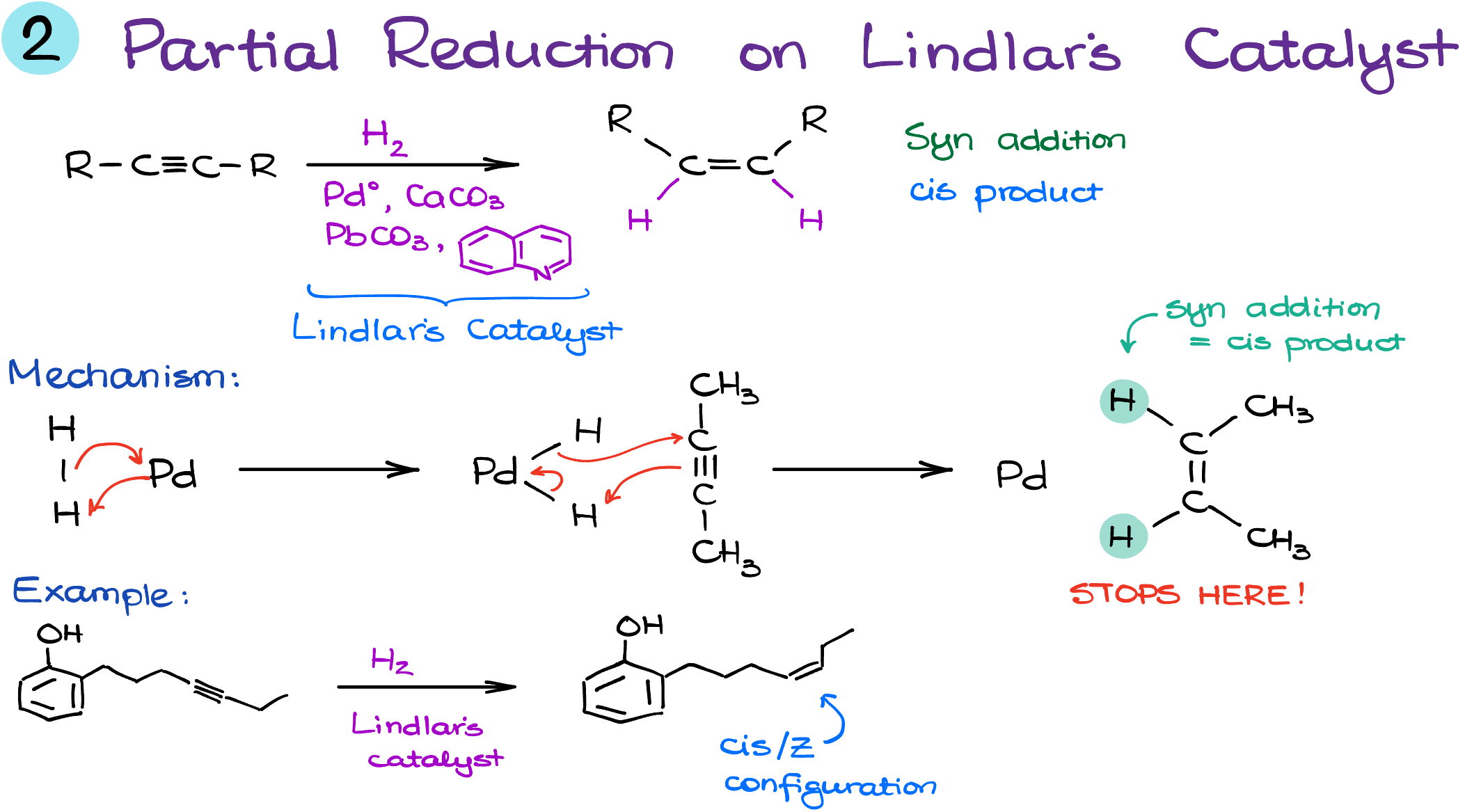
One option is Lindlar’s catalyst. Lindlar’s catalyst is palladium supported on calcium carbonate (Pd/CaCO3) and poisoned with, well, typically lead and quinoline. There are some other versions as well, but lead and quinoline are the most common ones. This poisoning allows the reaction to stop at the alkene and not go any further.
Mechanistically speaking, this reaction is exactly the same as the first step of the hydrogenation we just looked at, but it stops after the formation of the double bond and doesn’t reduce your molecule all the way. It’s a strict syn addition that yields a cis alkene as the product. This reaction was quite revolutionary when it was developed in the 1950s, as it gave scientists a neat and controlled way to partially reduce a triple bond.
Drawing the cis Product Correctly
But since it’s a syn addition, you’ve got to be very careful with how you show your products. Zigzagging the chains is a very natural way for us to draw molecules, but remember that we’re making a cis double bond here. So if your zig goes the wrong zag, so to speak, you’ll lose precious points on the exam. For instance, let’s look at this reaction over here. When I draw my product, I must choose the correct configuration for my double bond, like this. And please don’t even try to be cute and draw something of that sort.
Dissolving Metal Reduction: Sodium in Ammonia
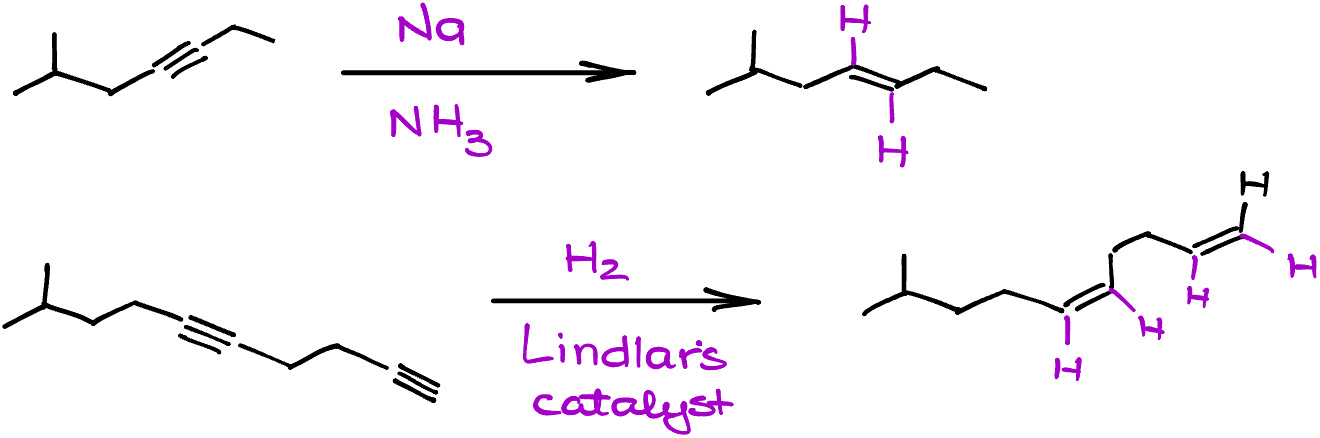
Now, where things get truly interesting is the partial reduction of alkynes using alkali metals like sodium or lithium in liquid ammonia. You can even try potassium if you’re brave enough. A fun fact is that solutions of sodium and potassium in ammonia have a beautiful blue color. Google it; it’s actually pretty cool.
Anyway, this reaction gives us a trans product, and it has a rather interesting mechanism.
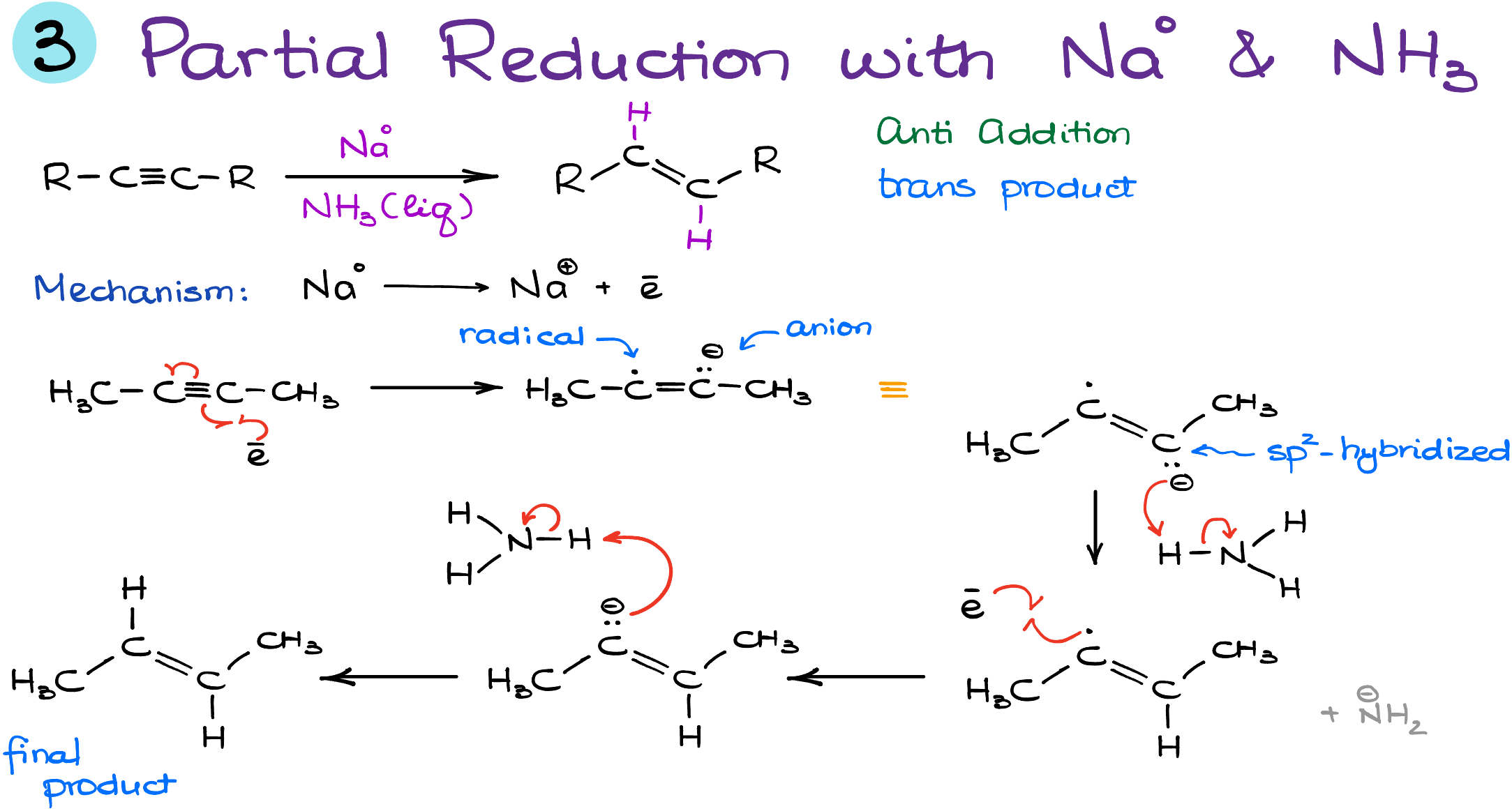
The Mechanism
First, sodium sheds an electron into the solution. Yes, I know it looks weird, but that’s literally why these solutions are blue: it’s the solvated electrons floating around.
Next, our electron bumps one of the π bonds of the alkyne to create a rather exotic species called a radical anion. Here we have an uncharged radical on one of our carbons and a full electron pair on the other carbon, which makes it negatively charged, or an anion, in other words. Importantly, though, this radical anion is no longer linear like the original alkyne. The middle atoms here are sp2-hybridized, which forces the molecule to bend and take on our familiar zigzag. This species is also most stable when one electron cloud points away from the other, so it essentially gives us the trans shape from the get-go.
Next, we do a proton transfer. In this case, ammonia (NH3) serves as our source of protons, and we make an amide anion (NH2–) as the conjugate base in this step. We still have the radical, so it grabs another electron from the solution like this, and that makes another anion. This anion then grabs a proton from another ammonia molecule, giving us the final product, the trans alkene.
And if your head isn’t spinning after seeing this mechanism, you haven’t been paying attention. We have everything here: full arrows, half arrows, radicals, anions, proton transfers, and acid-base reactions. We have it all.
Do You Need to Know This Mechanism?
Now, I have good news and bad news for you, my friends. The good news is that not that many instructors will test you on this mechanism, so double-check with your instructor whether you’re responsible for it on the test. The bad news is that this reaction will certainly be on the test whether or not you need to know the mechanism, so make sure you know this one. Remember, this reaction gives you a trans product, while the reduction with Lindlar’s catalyst gives you a cis product.
Examples and Common Pitfalls
Terminal Alkynes in Sodium and Ammonia
Now, let’s imagine we take a sample of hept-1-yne, or 1-heptyne if you like, and subject it to the conditions of this reaction. What’s the product going to be? You’re probably looking at me right now thinking this would just give a double bond, just like this one. After all, I literally just taught you this reaction, right?

Well, yes. But the inner Grinch in me refuses to start my examples section with a plain vanilla reaction that just works. If this reaction is performed as written, it will fail spectacularly. Why, you might ask? Oh boy, I’m glad you did.
Remember how this reaction produces the amide anion as a coproduct? Amide anions are basic, and I mean baaasic. So what are those amide anions going to start doing right away? Well, they’re basic, so they’ll start deprotonating your terminal alkyne, making it unreactive. That means that if you attempt this reaction on a terminal alkyne, you absolutely need some sort of proton source that constantly neutralizes the amide, so it can’t react with your starting material and render it essentially useless. However, if you do this reaction on an internal alkyne, there won’t be any problems, outside of the ammonia stench all over the lab, because, I mean, these reactions are stinky.
The reaction with Lindlar’s catalyst has no weird limitations or tricks associated with it, and it works just fine on both internal and terminal triple bonds, like in this example.
Molecules with Multiple Unsaturations
And of course, if you have multiple triple bonds in your molecule, all of these reactions will tackle all of your triple bonds across the board. None of the methods I just showed you can pick one triple bond over another. However, remember that Lindlar’s catalyst and sodium in ammonia won’t do anything to the double bonds you might already have in your molecule, while hydrogen on pure palladium will reduce everything.
For instance, in this reaction, my double bond is safe: I had a double bond to begin with, and after the reaction, I still have my double bond. In the other molecule, on the other hand, the double bond and the triple bond are both completely reduced; they’re just gone.

Concluding Thoughts
Alkyne reductions are a fascinating field, and there are a few things to keep in mind. Alkynes can be partially reduced using either the Lindlar’s catalyst or alkali metals in liquid ammonia. The Lindlar’s catalyst gives you a cis product, while the alkali metals give you a trans product. But be careful with certain reactions, especially when working with terminal alkynes. The reaction with sodium in ammonia can make terminal alkynes unreactive, but the Lindlar’s catalyst doesn’t have that problem. Also, both the Lindlar’s catalyst and sodium in ammonia keep the double bonds, but using hydrogen on pure palladium will reduce all multiple bonds, turning both double and triple bonds into single bonds.
Practice Questions
Additional practice questions and answer keys are available to site members.
Sign up today or login if you’re already a member and unlock all members-only content!
For students who want structured organic chemistry practice and clear explanations, and get feedback when stuck.
Organic Chemistry Tutor Membership Includes:
✅ 300+ Detailed organic chemistry tutorials with members-only sections
✅ 1500+ Practice questions with detailed answer keys
✅ Downloadable Workbooks with detailed answer keys
✅ Access to the PDF Resource Library (aka Organic Chemistry Notes)
✅ Q&A and email feedback directly from Victor
Build understanding before your exams.
$39 / month
Renews monthly
Cancel anytime
* Feedback is constructive and instructive in nature. Show me your work and I’ll show you where it breaks or give you pointers where you need to go. I typically answer all questions within 24 hours.